
I started writing this story in December 2020, in the middle of a pandemic. The world had gone quiet in ways we hadn’t chosen — we were separated, stuck indoors, and technology had become the only thread connecting us to the outside world. We didn’t know then how long it would last, or what would remain when it was over.
A bird sang outside my bedroom window at 5 AM and I couldn’t remember the tune by morning. That small loss stayed with me.
I finished the story in April 2026, in a world now full of different conversations: about AI, about how technology is impacting our everyday living, about our responsibilities to each other and to what it means to be human. The ending came to me in Forsyth Park, with EarPods in my ears and the hooting of a barred owl.
This is what happened in between…
I.
December 23, 2020
It is 5:00 AM when the bird begins to sing outside our bedroom window. The city is still mostly dark, just a few street lights casting their pale orange glow across the ceiling, and the sound arrives into all of that quiet, sudden, and completely unexpected.
The bird sings for a little while. An unhurried melody, as if it has all the time in the world. And then it stops. The silence that follows is so deep it has a weight to it, as if the sound had been holding the air up and now the air has simply collapsed.
Are you awake?
Yes.
Did you hear the bird sing?
Yes. It was beautiful.
What do you think it was about?
The bird must have had a bad dream.
No. The singing was so joyful. So carefree. Maybe it was a good dream.
Maybe, I say. And I mean it. Maybe it was exactly that.
We lie there for a while without speaking. A few minutes pass, or maybe more. It’s the kind of hour where time moves differently.
What are you thinking about? he asks.
I can’t remember the tune, I tell him. It just happened and already it’s dissolving, the way dreams dissolve in the first minutes of waking. It’s like you reach for them and find only the feeling of having had them, not the thing itself. I try to reconstruct it: the first note, where it rose, where it fell, whether it repeated. Nothing. Only the fact of it remains, like an outline with everything inside erased.
(I think, briefly: I wish I had recorded it. And then I think: what an absurd idea. It lasted only a few seconds, and I was so completely inside it that stepping outside to reach for my phone would have been like stepping outside of something I can never fully name. I wouldn’t have done it. I’m glad I didn’t.)
But you have a memory of the bird, he says gently.
Even that is fading, I tell him. Even that.
We linger in silence for a few more minutes. And then the city begins its morning routine; the trash truck somewhere down the block, more lights flickering on in the apartment building across the street, a neighbor’s dog barking in the distance. I listen for something underneath all of it, something small and alive.
No birds.
I get up and make coffee. I carry the cup to the green sofa in the living room and sit down, wrapping both hands around the warmth of it, and I look slowly around the room the way you do when you’re trying to locate yourself; the plants, the books, the particular slant of early light beginning to come through the window. It is 5:15 AM and the world is very quiet and still and I am trying to hold onto something that is already gone.
He comes through the living room eventually, still half asleep, and disappears into the kitchen. A few minutes later he comes back and sits in the chair by the coffee table, cradling his cup in his hands the same way I am cradling mine.
Can you imagine the city without birds? I ask, not looking at him.
I don’t want to think about it, he says quietly.
And we sit with that, in silence.
* * *
January 1, 2026
It is 12:00 PM and the recordings of bird songs blast through the loudspeakers in the streets.
I think about a close friend I lost about eight years ago. I still keep a few of her voice messages on my phone, and once a year I sit down and listen to them. Her voice is soft and kind, full of warmth and care, and she always ended every call the same motherly way: I love you. I cannot remember her voice on my own anymore; it has faded the way the bird’s song faded, faster than I expected and more completely than I was prepared for. But when I press play and hear her, the heart remembers. Something that had gone quiet in me comes back online, just like that.
I think about that now, sitting midday on the green sofa in the living room. And I think: it doesn’t work that way with birds. The recordings of bird songs, the ones they play in the city now, can no longer reach that place. People’s hearts have grown cold to them, and the city has grown cold too, and I don’t fully understand why, but I feel it. I have felt it for a while.
It’s already happening. The city is crying, I think. It feels withdrawn. Like it’s curled up in some dark corner and can’t find its way out.
II.
The city has a faint memory of birds, but it can no longer remember the singing. The memory is there in the way that the memory of a smell is there, or the memory of the taste of Proust’s Madeleines; you know that you knew it, you know that it mattered, but the actual sensation is gone, replaced by the knowledge of its absence. The void it has left behind is not empty. It is full of something that presses against the chest from the inside, something that has no name because no one has yet thought to name it.
People walk through it anyway. They have learned to.
By order of the local council, every day at noon and 6:00 PM, loudspeakers mounted on lampposts by the basketball and tennis courts and the sides of buildings around the squares in Savannah play recordings of bird songs. A northern cardinal. A mockingbird. A barred owl. Something that might be the brown-headed nuthatch. The recordings are technically perfect, clear and bright and exactly right in every measurable way. They last ten minutes. People in the streets pause when they hear them. Some tilt their faces upward. Some close their eyes. And then the ten minutes end, and they keep walking, and life goes on, and the absence settles back in around them like water filling a hole.
A man stops under a lamppost to listen one afternoon, his hands deep in his coat pockets, his head tilted in that particular way — the way you tilt your head at a painting in a gallery when you’re trying to feel something you think you should be feeling. It is the posture of effort. It is not the same as the thing itself.
The recording ends. He keeps walking.
* * *
III.
I don’t know exactly when I understood what I had to do. It didn’t come all at once. It arrived the way these things tend to arrive, gradually, then undeniably. First as a low hum of unease I couldn’t account for, then as a thought I kept returning to without meaning to, and finally as the only possible conclusion.
I am the last one left with a real memory of birds. Not a recording, not a photograph, not a description in a book. A memory, lived, sensory, unrepeatable. The bird outside the window at 5 AM. The tune I can no longer recall but whose existence I can still feel the way you feel a word that has slipped away from you: the shape of it, the weight of it, the certainty that it was there. That it was real.
If I forget, there is no more hope. The birds won’t come back. But if I can find the lost song, not record it, not store it in any device, but genuinely recover the living sound of it, they will return. I don’t know how I know this. I know it the same way I knew to get up and make coffee at 5:15 AM, the same way I knew to hold the cup in both hands. Some things don’t require explanation. They just ask you to begin.
So I begin to walk.
I move through the city the way you move through a dream you’re trying to re-enter, not frantically, not following any map, but with a kind of patient attention, the way you hold very still when a bird has landed near you and you don’t want to frighten it away. I am listening for something I cannot describe, because I can barely describe it to myself. A quality of air. A gap in the sound of things. The particular silence that precedes something alive.
I carry a notebook everywhere now. I write down small things: a tree whose leaves moved when there was no wind; a child who stopped mid-stride for no visible reason and looked straight up at the sky; a woman sitting alone on a bench whose face had gone somewhere else entirely, somewhere far and interior and unreachable. I don’t yet know what I’m collecting. I collect it anyway, trusting that the pattern will eventually reveal itself — the way it always has, if you’re patient enough, if you stay curious enough, if you keep looking.
At night I come home. He is reading, or already asleep. I sit on the green sofa and read back through what I’ve written, holding the warm cup, and I try, one more time, to remember.
* * *
IV.
The playground near the school is rubber and painted metal, bright primary colors, designed for safety and durability. There are no trees. In the places where trees might once have been, there are structures shaped to suggest trees, smooth trunks, outstretched branches, everything rounded at the edges. The children climb them without thinking twice, because children climb what is in front of them, and what is in front of them is what the world is.
They are five and six and seven years old, and they are loud and full of the particular energy of children who have been sitting still all morning and have just been released. They chase each other across the rubber surface, fall, get up, keep going. They do not notice the absence of birds, because you cannot notice the absence of something you have never known. The absence is simply the shape of the world. It has always looked like this.
Inside the kindergarten, one hour every day, the children sit with small white devices fitted gently over their ears. The devices play bird songs, the same recordings that come through the lampposts at noon, the same northern cardinal, mockingbird, and barred owl and possible brown-headed nuthatch. There are also games: colorful, well-designed games that teach the children about birds, their habits, their habitats. Nests. Eggs. Migration routes drawn across illustrated maps. The children are good at these games. They can identify a robin by the markings on its chest. They know that swallows return each spring and leave each autumn and that this has always been the way of things.
They know all of this, and none of it is real, and they know that too, in the wordless way that children understand the difference between a thing and a picture of a thing, even when no one has explained it to them.
One girl, six years old, a gap where her front tooth was until recently, slides her headset off during the listening hour and holds it in her lap, sitting very still with her hands folded over it. Her teacher notices and comes over.
Put your headset back on, please.
The girl looks at the window for a moment. The street outside, the lamppost, the flat grey sky above the rooftops. Then she puts her headset back on and the bird songs resume, clear and technically perfect, filling her small ears.
But for that moment, she was listening for something else. Something she has no name for. Something she somehow knows she has not yet heard.
* * *
V.
The devices are elegant, small and white and designed to fit neatly over the ear with a satisfying precision. The local council distributed them in two waves: first to children, then to adults. The accompanying booklet, translated into fifty languages, explains that wearing the device for at least thirty minutes each day will restore memory and promote harmony. The cover of the booklet shows a small illustration of a bird on a branch. It is a nice illustration. It is very accurate.
I wear mine faithfully for three weeks. Then I stop.
The recordings themselves are not unpleasant. They are, in fact, technically perfect in every way that can be measured. But I find, sitting with it in the evenings, that what the device does is fill the space where the memory used to live. And a filled space, I have come to understand, is not the same as a recovered one. You can pack something full of the right sounds and the right frequencies and the right bird and still have only a full space, not the original thing. The original thing was alive. It moved through air. It came from somewhere and went somewhere. You cannot put that in a device.
The more faithfully you wear it, I tell him one evening, the less able you become to recognize the real thing. The recordings train the ear. And a trained ear will hear a recording even when what it’s actually hearing is the opposite — even when what it’s hearing is real.
He looks at me over his cup.
So if a real bird sang right now…
Almost no one would know, I say. They would hear it and think: that sounds like the recording. And they would feel, briefly, the thing the device is supposed to make them feel. And they would be satisfied. And the bird would go unrecognized.
He is quiet for a moment, turning this over.
Would you know? he asks.
I look at my cup. I think about the bird at 5 AM, the tune that dissolved before I could catch it, the outline with everything inside erased. I’m not sure, I tell him. That’s exactly why I’m still looking.
* * *
VI.
It happens in the early morning, before the city has fully woken up, which is the only time the streets are quiet enough to hear anything underneath the noise of everything. I have been awake since before dawn. I often am these days, and I am sitting on a bench in one of Savannah's squares near our building, the one with the rubber paths and the metal trees, with my notebook open on my lap and nothing written in it.
I have learned, over these weeks of walking and listening, that you cannot go looking for it directly. Looking is the wrong instrument. What you have to do is become very still and very open, the way you have to become still when you want a wild thing to come near you. You have to make yourself into the kind of place it might want to land.
So I am sitting there, not searching, and I am thinking about my friend who passed away over eight years ago; about her voice messages, about the way her voice returns to me when I hear the recordings, not just as a sound but as a presence, as the full weight of who she was; and I am thinking about how a voice carries something that a transcript never can, something that lives in the frequency of it, in the breath between the words.
And then.
One note.
And then a few more.
I stop breathing. I am afraid that if I move, it will stop. I am afraid that it is not real, that it is the device’s influence, that my trained ear is constructing a recording out of ambient sound and wishful thinking. And I am afraid that it is real and I will not be able to tell, and in the gap between those two fears there is something else entirely, something warm and enormous and quiet, something that feels like the opposite of every fear I have ever had. I don’t have a word for it. The word has been fading from me for a long time now, the way the tune faded on the morning this all started.
The sound is different from the recordings.
I know this immediately, and then I doubt it immediately, and then I know it again, and the knowing is steadier this time. The difference is not in the notes, a northern cardinal, I think, or something close to one. The difference is in what the sound does to the air around it. A recording fills space. This displaces it. This sound has a weight, has direction, arrives from somewhere specific and moves toward somewhere else. It is not a captured thing being played back. It is a thing that is happening, right now, in real time, in the particular 6 AM air of this particular city in this particular world.
I open my notebook. I do not write anything. I just hold it, and I listen, and I let it be what it is.
The bird sings for a few minutes and then stops. The silence that follows is different from the silence I have been living inside. This one has something in it.
I sit for a long time after. I am trying to hold the sound, knowing I will lose it, knowing that living things do not stay, that they pass through and leave only evidence of having been there, only some change in the air, some shift in the quality of the light, some alteration in the person who was sitting still enough to receive them. Not the tune. Not even the memory of the tune. But something behind it. Something that cannot be recorded, only felt, only carried.
The city is beginning to wake around me. I stand up, eventually, and I walk home.
* * *
VII.
He is still asleep when I get back. I move quietly through the apartment, make coffee, and carry it to the green sofa, where I sit in my usual spot with the cup in both hands and watch the light come in through the window at its morning angle, falling across the plants, across the books, across everything that is familiar and still here.
I don’t know if the birds will come back.
I don’t know if what I heard this morning was one bird or the beginning of many, whether it was a sign or just an accident, whether anyone else in the city was awake at that hour and still enough to hear it. I don’t know if the girl, the one who slid off her headset and looked out at the street and the sky, I don’t know if she heard something this morning, or is still listening for it, or will grow up knowing that there is something worth listening for.
I hope. That is all I have, and it turns out to be enough to keep moving. I hope.
When he comes out of the bedroom later, still creased with sleep, I hand him a cup without saying anything and he takes it and sits down in his chair and we are quiet together for a little while, which is one of the things I love most about our life; that we know how to be quiet together, that silence between us is never empty.
You went out early, he says eventually.
Yes.
And?
I look at the window. A truck passes somewhere below. Voices. A door. The city going on in its way, indifferent and alive.
I heard something, I tell him. I think it was real.
He looks at me for a moment across the steam rising from his cup. Then he nods, just once, quietly, and takes a sip of his coffee. He believes me. He has always believed me. That is the whole of it.
I hold my cup in both hands and turn back to the window.
I listen.
* * *
VIII.
April 1, 2026
It is late afternoon and I am sitting on my green sofa, leaning over the laptop on the coffee table, and I need to stop. My head is aching. I have been listening to bird recordings for over five hours today, longer than usual, trying to extract something from them, some essence I could press into the character I am writing, so that when she hears the real thing she will know the difference because I know the difference. That is how it works. The writer has to live inside the thing before the character can.
I close the laptop.
I have also been turning over a conversation I had with friends recently — a long, rambling, honest conversation about how quickly everything is shifting around us, the landscape of ordinary life quietly being rearranged by technologies that arrived so gradually and then all at once. We talked about what we are losing without fully registering the loss. About how you can be surrounded by the world and still, somehow, be inside a sealed room of your own making. Nobody had a solution. We just named it, carefully, and that felt like something.
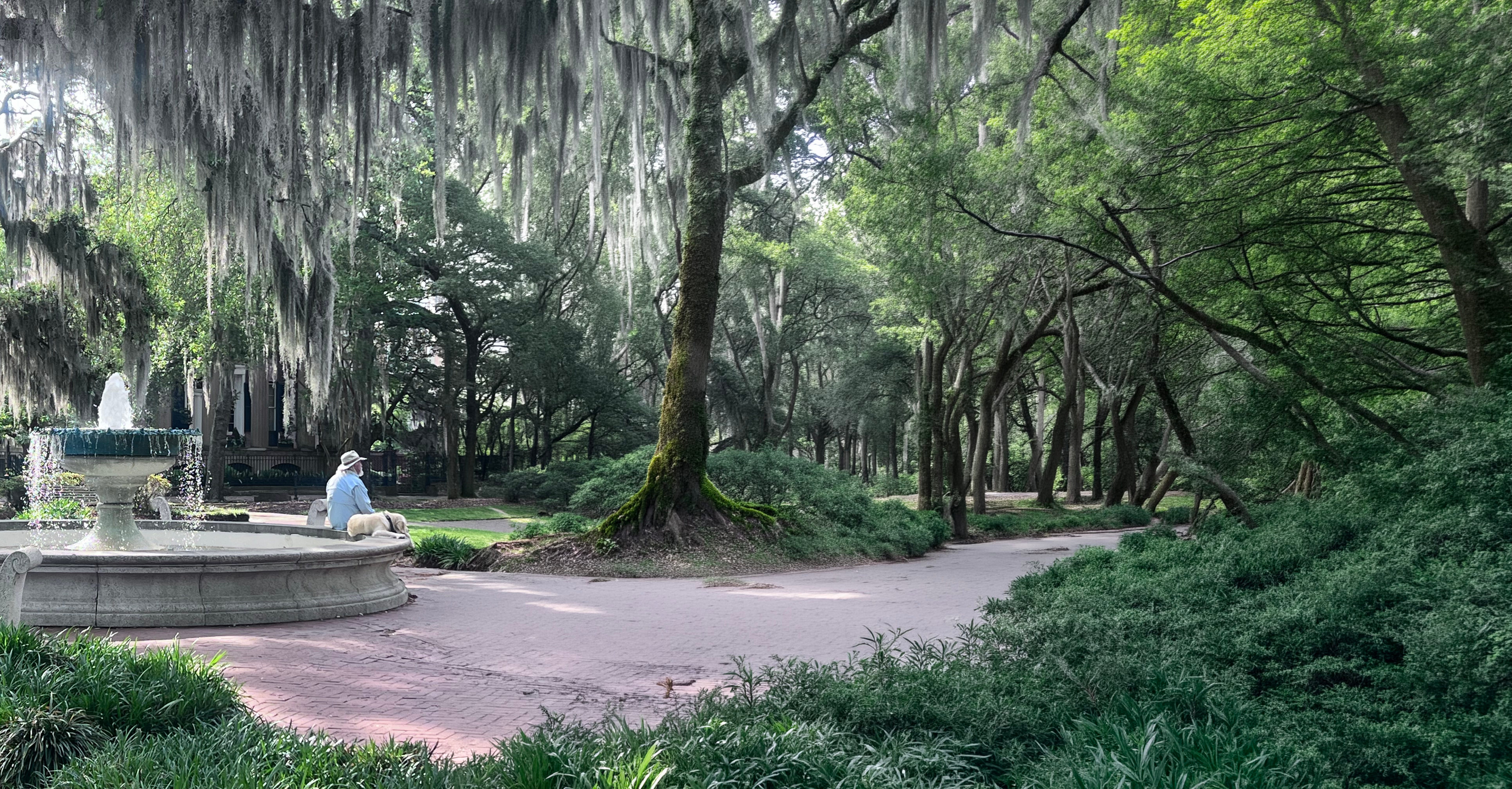
I decide to go for a walk through one of Savannah's squares, the live oaks, the fountain, the particular quality of late afternoon light that Savannah does better than almost anywhere. I need air. I need to not be thinking about any of this for twenty minutes.
I step outside the building and reach into my pocket and take out my EarPods — small and white, exactly like the devices in the story I am writing, which I notice only now and choose not to think about — and I press them into my ears and turn on the music and start walking.
I am maybe two minutes into my first lap around the park when I feel it. Not hear it. Feel it first, the way you sometimes sense a presence before you can account for it. A low, resonant pulse of sound moving through the music, or underneath it, or around it. My body registers something that my ears, sealed inside their small white devices, cannot quite confirm.
A barred owl. Hooting.
There is no way. The EarPods are good at blocking the world out. That is the point of them. That is what I bought them for.
But the feeling doesn’t leave, and after a few seconds I do something I almost never do in the middle of a walk when the music is exactly right: I stop. I take the EarPods out of my ears. I stand very still on the path with the late light coming through the Spanish moss and I wait.
Silence.
The barred owl hoots.
Real, unmistakable, close enough that I can feel it in my chest as much as hear it, that low, carrying, almost conversational and ominous sound that barred owls make, as if they are asking a question they already know the answer to. I stand there for a while and just listen and the owl keeps going, unhurried, as if it has all the time in the world. And then, after a few minutes, it goes quiet.
I look down at the EarPods I am clutching in my right hand.
The irony is not subtle. I was trying to disconnect, but from what, exactly? I had sealed myself inside music to get away from my thoughts and my most immediate surroundings, and in doing so had nearly walked right past the thing I have been writing about for months, the thing I have been listening to bird recordings for five hours today to try to understand. The real sound was right there. I almost missed it entirely.
I stand there a little longer in the fading afternoon, holding the EarPods, thinking about the conversation with my friends, thinking about the story on my laptop, thinking about how fast we move and how much moves past us as a result. I think about the playlist of natural sounds that has always run underneath our lives — the birds, the wind in specific trees, the particular acoustics of a place that is actually outside — and I wonder how many tracks we have already lost without noticing, quietly deleted, the library shrinking while we were listening to something else.
How close are we, really, to losing the song?
I put the EarPods in my pocket and walk the rest of the way around the park without them. I watch dogs playfully chase each other. Squirrels run up and down the trees. Spanish moss sways gently in the live oaks. Somewhere nearby, fragrant jasmine is blooming.
Every evening at 6:00 PM a barred owl stops by a tree outside my bedroom window and starts hooting. I wonder if it has always been there, and I am just starting to notice it.